
The Remarkable History of America as a Christian Nation
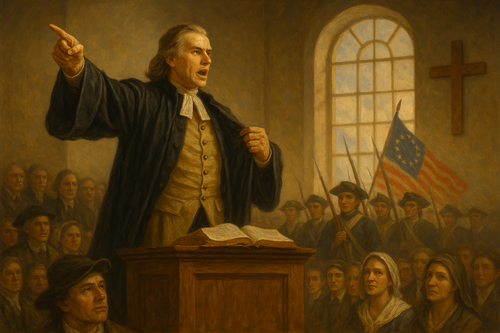
What if I told you the American Revolution wasn’t only born on battlefields… but in churches? That before muskets fired, pulpits thundered?
This is the story you were never told in school.
This is the story you were never told in school.
The Pulpits that Roared
British soldiers had a nickname for America’s pastors: the “Black Robe Regiment.”
Why? Because every Sunday, black-robed preachers stood before their congregations and lit a fire that no empire could quench. They preached liberty from the Scriptures. They declared tyranny a sin against God. And their sermons spread faster than any pamphlet.
One famous example: Rev. John Peter Muhlenberg. On January 21, 1776, he preached from Ecclesiastes: “There is… a time for peace, and a time for war.”
Then, right there in the pulpit, he tore off his robe and revealed a soldier’s uniform beneath. “This is the time,” he declared. That day, over 300 men from his congregation enlisted.
Imagine it: one sermon emptying the pews into an army camp. That’s the power of the pulpit.
Why? Because every Sunday, black-robed preachers stood before their congregations and lit a fire that no empire could quench. They preached liberty from the Scriptures. They declared tyranny a sin against God. And their sermons spread faster than any pamphlet.
One famous example: Rev. John Peter Muhlenberg. On January 21, 1776, he preached from Ecclesiastes: “There is… a time for peace, and a time for war.”
Then, right there in the pulpit, he tore off his robe and revealed a soldier’s uniform beneath. “This is the time,” he declared. That day, over 300 men from his congregation enlisted.
Imagine it: one sermon emptying the pews into an army camp. That’s the power of the pulpit.
Colonial Charters: A Sacred Mission
Even before America was a nation, the settlers made their intentions clear.
The Mayflower Compact of 1620 stated that the colony was planted “for the glory of God and the advancement of the Christian faith.” The Virginia Charter of 1606 declared the same purpose. These weren’t ceremonial words. They were mission statements.
The earliest colonies didn’t just seek survival. They sought to build communities where the gospel could flourish, and the Christian faith could be advanced.
The Mayflower Compact of 1620 stated that the colony was planted “for the glory of God and the advancement of the Christian faith.” The Virginia Charter of 1606 declared the same purpose. These weren’t ceremonial words. They were mission statements.
The earliest colonies didn’t just seek survival. They sought to build communities where the gospel could flourish, and the Christian faith could be advanced.
The Faith Woven Into Founding Documents
We often hear the Declaration of Independence doesn’t mention Jesus — and that’s true. Instead, it speaks of a Creator, Divine Providence, and the Supreme Judge of the world.
But look closer at the state constitutions written between 1776 and 1784. Eleven of thirteen states required leaders and officeholders to confess belief in “God the Father, Jesus Christ His only Son, and the Holy Ghost.” Others used broader phrases like “the Christian religion” or “Supreme Being.”
And go back even further: the Mayflower Compact and colonial charters declared the very purpose of settlement was “the glory of God and the advancement of the Christian faith.”
Faith wasn’t an afterthought. It was the reason.
But look closer at the state constitutions written between 1776 and 1784. Eleven of thirteen states required leaders and officeholders to confess belief in “God the Father, Jesus Christ His only Son, and the Holy Ghost.” Others used broader phrases like “the Christian religion” or “Supreme Being.”
And go back even further: the Mayflower Compact and colonial charters declared the very purpose of settlement was “the glory of God and the advancement of the Christian faith.”
Faith wasn’t an afterthought. It was the reason.
The Hidden Fuel: Revival
Here’s the piece most history books skip: before the Revolution ever began, America had been swept by the First Great Awakening.
Preachers like George Whitefield and Jonathan Edwards awakened the colonies with a vision of God’s glory and man’s responsibility. Revival stirred ordinary farmers and merchants to believe that they answered to God first — and to no earthly king above Him.
That revival prepared the soil for revolution. By the 1770s, liberty wasn’t just a political idea. It was a biblical conviction.
Preachers like George Whitefield and Jonathan Edwards awakened the colonies with a vision of God’s glory and man’s responsibility. Revival stirred ordinary farmers and merchants to believe that they answered to God first — and to no earthly king above Him.
That revival prepared the soil for revolution. By the 1770s, liberty wasn’t just a political idea. It was a biblical conviction.
Why It Still Matters
America wasn’t built by saints alone, and not every founder was a devout Christian. But let’s not forget: without the pulpits, without revival, without the fiery sermons that made British officers tremble, there may never have been a Revolution at all.
We live today in the tension of that legacy. America is not heaven’s kingdom. Yet her birth reminds us that when the people of God rise in faith, even empires can fall.
The Revolution was more than muskets and treaties. It was revival dressed in a soldier’s coat.
We live today in the tension of that legacy. America is not heaven’s kingdom. Yet her birth reminds us that when the people of God rise in faith, even empires can fall.
The Revolution was more than muskets and treaties. It was revival dressed in a soldier’s coat.
Recent
Archive
2025
June
August
September
October
November
2024
No Comments